Faculty Mentor
Anne E. Pfister, PhD
Faculty Mentor Department
Department of Sociology, Anthropology, and Social Work
Abstract
Papernest Media is a collaborative multimedia research project that contextualizes the history and contemporary status of insect commodities as traditional food, tourist fare, and natural dye in Oaxaca, Mexico. Our interdisciplinary team of Anne E. Pfister, PhD in Applied Medical Anthropology, Alex Kledzik, BA in Sociology and Susie Mabry, UNF International Studies, came together in 2024 to produce a short film accompanying the exploratory phase of a larger ethnographic investigation. In July 2024, we traveled to Oaxaca during a peak season and the annual Guelaguetza festival to investigate the touted sustainability of edible insects in a region known for its long-standing culinary use of insects. After returning from Oaxaca, we analyzed the images we captured and developed Papernest Media (PN) to house our work as both an archive and a dialogic space.
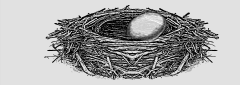
The QR code will take you to our website, papernest.domains.unf.edu, which combines visual anthropology, documentary film, and text-based research to produce an evolving archive of media and reflection. The name Papernest is inspired by the paper wasp (Polybia occidentalis), an insect that creates delicate and elaborate nests from chewed paper fibers. The paper wasp is embedded in both the ecological and cultural landscapes of the Zapotec people as a seasonal culinary tradition—one we were fortunate to experience firsthand. The Papernest website is “home” to collaborative film, photography, and publications, all of which are collectively constructed and shared. Rather than presenting polished narratives or conclusions, our media functions as both a research method and a way to pose and explore anthropological questions.
During our 2024 trip to Oaxaca, fieldwork shifted my role from passive observer to active investigator. Incorporating ethnographic techniques into my film and storytelling made me feel that I was not only documenting but dwelling within moments of exchange. Film transcends writing and traditional ethnographic research, offering a unique method of inquiry demanding curiosity, openness, and presence. Each encounter felt more fully captured and explored with the aid of the camera, and translating these insights into a visual language became a language-learning endeavor of its own. We hope this project continues to traverse both disciplinary and cultural boundaries—and most importantly, to engender appreciation of caring for cultural knowledge and biodiversity.
Recommended Citation
Mabry, Susie V.
(2025)
"Papernest Media: A Collaborative Multimedia Research Project,"
PANDION: The Osprey Journal of Research and Ideas: Vol. 6:
No.
1, Article 9.
Available at:
https://digitalcommons.unf.edu/pandion_unf/vol6/iss1/9
Included in
Accessibility Statement
This item was created or digitized before April 24, 2027, or is a reproduction of legacy material created before that date. It is preserved in its original, unmodified state specifically for research, reference, or historical recordkeeping. In accordance with the ADA Title II Final Rule, the Library provides accessible versions of archival materials by request. If you are experiencing difficulty accessing the information on the site due to a disability, please submit a request through the following form for assistance.